
Airworthiness vs Continuing Airworthiness: What’s the Difference?
Introduction
If you have spent any time around aircraft maintenance or CAMO, you have probably heard “airworthiness” and “continuing airworthiness” used almost interchangeably. They are not the same thing, and mixing them up can lead to real confusion about who is responsible for what.
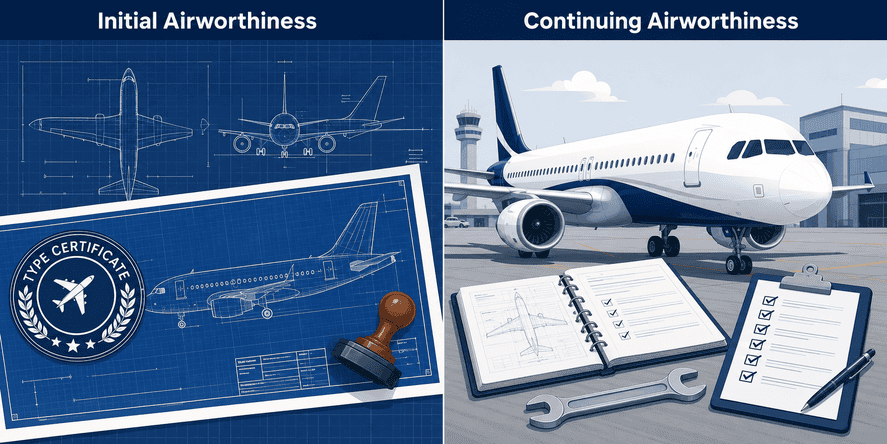
In simple terms: airworthiness is the condition of an aircraft being safe to fly, first established when the aircraft is designed, built, and certified. Continuing airworthiness is the ongoing process of keeping that aircraft in a safe, compliant condition for as long as it remains in service.
One is a starting point. The other is a continuous obligation that never really ends until the aircraft is retired.
This distinction matters more than it might seem. Understanding it correctly helps engineers, CAMO staff, and even pilots understand where certification responsibilities end and operational maintenance responsibilities begin. It also clears up a common misconception: that an aircraft, once certified airworthy, stays that way automatically. It does not.
By the end of this article, you will understand exactly where airworthiness ends and continuing airworthiness begins, how regulators define each term, and why the difference matters in daily aviation operations.
What Does “Airworthiness” Actually Mean?
Airworthiness, in its broadest sense, means an aircraft is safe to operate in the conditions and manner for which it was designed. It is not just a general safety impression. It is a formal, regulated status.
An aircraft is considered airworthy when:
- Its design meets an approved set of safety standards (a type certificate)
- Its condition conforms to that approved design
- It is in a condition for safe operation
That third point is important. An aircraft can have a perfectly valid design approval and still not be airworthy right now, for example, if a component is worn beyond limits or a required inspection is overdue.
Initial Airworthiness: Where the Story Begins
Initial airworthiness (sometimes just called “airworthiness” in casual conversation) refers to the certification process that happens before an aircraft ever enters service. This is where the aircraft’s design is proven safe.
This phase is handled primarily by the manufacturer and the certifying authority, not by the airline or CAMO organization. It includes:
- Design development and testing
- Structural, systems, and performance validation
- Issuance of a Type Certificate (TC)
- Issuance of a Certificate of Airworthiness (CofA) for each individual aircraft once built
Under EASA regulations, this process falls under Part-21, which governs the certification of products, parts, and appliances. The FAA equivalent is found in 14 CFR Part 21.
Once an aircraft receives its Certificate of Airworthiness, it is legally permitted to fly. But that certificate is not a lifetime guarantee. It reflects the aircraft’s condition at a specific point, and it depends on continuing compliance with maintenance requirements to remain valid.
Continuing Airworthiness: Where the Real Work Happens
This is where continuing airworthiness takes over. Once an aircraft is delivered and enters service, someone has to make sure it stays in that certified, safe condition for the rest of its operational life.
Continuing airworthiness is defined by ICAO Annex 8 and echoed in EASA and FAA regulations as the set of processes that ensure an aircraft, at any given time, remains compliant with applicable airworthiness requirements and is in a condition for safe operation.
In practice, this includes:
- Scheduled maintenance according to an approved maintenance program
- Compliance with Airworthiness Directives (ADs)
- Embodiment of applicable Service Bulletins (SBs) where mandated
- Component life tracking and replacement
- Defect rectification
- Records keeping and technical documentation control
- Reliability monitoring
This is the domain of CAMO (Continuing Airworthiness Management Organisation), along with maintenance organizations, engineers, and quality departments. If you want a deeper breakdown of how CAMO fits into this picture, see my related article, What Is CAMO, which covers the organization’s structure and responsibilities in detail.
The Regulatory Framework Behind Both Concepts
Different regulators use slightly different terminology, and it is worth being precise here rather than assuming everything lines up exactly.
ICAO sets the international baseline through Annex 6 (Operation of Aircraft) and Annex 8 (Airworthiness of Aircraft). ICAO does not directly regulate airlines; it sets standards that member states adopt into national law.
EASA, within the European Union framework, splits the regulatory structure clearly:
- Part-21 covers initial airworthiness (design and production approval)
- Part-M (and increasingly Part-CAMO/Part-CAO under recent restructuring) covers continuing airworthiness
- Part-145 covers maintenance organizations performing the actual work
- Part-66 covers the licensing of maintenance personnel
FAA, under 14 CFR, does not use a “Part-M” style structure. Instead, continuing airworthiness responsibilities are spread across:
- 14 CFR Part 21 (certification)
- 14 CFR Part 43 (maintenance, preventive maintenance, rebuilding, and alteration)
- 14 CFR Part 91/121/135 (operational requirements depending on operation type)
This is a meaningful difference. EASA operators talk about “CAMO” as a defined organizational structure with its own approval. FAA operators generally do not use that exact term; airworthiness responsibility sits more directly with the operator’s maintenance program and the certificate holder, often overseen through an approved Continuous Airworthiness Maintenance Program (CAMP) for Part 121 carriers.
If you operate internationally, or work for an airline transitioning between regulatory systems, this difference is not just academic. It changes what documentation, approvals, and organizational structures are required.
Who Is Responsible for Each Phase?
| Responsibility Area | Initial Airworthiness | Continuing Airworthiness |
|---|---|---|
| Primary responsible party | Aircraft/type certificate holder (manufacturer) | Operator / owner, supported by CAMO |
| Regulatory basis (EASA) | Part-21 | Part-M / Part-CAMO |
| Regulatory basis (FAA) | 14 CFR Part 21 | 14 CFR Part 43, CAMP under Part 121 |
| Key output | Type Certificate, Certificate of Airworthiness | Maintenance program compliance, valid Airworthiness Review Certificate (ARC) |
| Timing | Before and during aircraft manufacture | Throughout the aircraft’s operational life |
| Focus | Design safety and build conformity | Ongoing condition and compliance |
A Practical Example
Consider a Boeing 737-800 delivered new to an airline. At delivery, it holds a valid Certificate of Airworthiness because Boeing designed it to an approved type certificate and built it in conformity with that design.
Five years later, that same aircraft has flown thousands of cycles. Components have worn. Airworthiness Directives have been issued. Scheduled checks have been performed. None of this changes the original type certificate. What keeps this aircraft legally and physically airworthy today is the continuing airworthiness process: maintenance program compliance, AD embodiment, and up-to-date records.
If the airline’s CAMO stopped monitoring ADs or let scheduled checks lapse, the aircraft’s initial certification would still exist on paper, but the aircraft itself would no longer be airworthy in practice. This is exactly why regulators require an Airworthiness Review Certificate (ARC) under EASA, renewed periodically, to confirm continuing airworthiness independently of the original Certificate of Airworthiness.
Comparison Table: Airworthiness vs Continuing Airworthiness
| Aspect | Airworthiness (Initial) | Continuing Airworthiness |
|---|---|---|
| Definition | Aircraft design and build meet approved safety standards | Aircraft remains compliant and safe throughout its service life |
| When it applies | Before entry into service | Entire operational lifespan |
| Who manages it | Manufacturer / Type Certificate holder | Operator, CAMO, maintenance organizations |
| Key document | Certificate of Airworthiness | Airworthiness Review Certificate, maintenance records |
| Regulatory reference (EASA) | Part-21 | Part-M / Part-CAMO |
| Regulatory reference (FAA) | 14 CFR Part 21 | 14 CFR Part 43, CAMP (Part 121) |
| Nature of process | One-time certification event | Continuous, recurring process |
| Failure consequence | Aircraft cannot be certified | Aircraft grounded or certificate suspended |
Aviation Perspective
Operational implications: Flight operations depend entirely on continuing airworthiness being maintained day to day. A dispatcher or pilot checking aircraft status is really relying on the continuing airworthiness process, not the original type certificate, to confirm the aircraft is fit to fly today.
Maintenance implications: Engineers working on the line or in base maintenance are the practical enforcers of continuing airworthiness. Every task card signed off, every AD embodied, and every deferred defect tracked through the MEL contributes directly to this ongoing status.
CAMO implications: CAMO exists specifically because continuing airworthiness requires active, organized management. It is not enough to have good engineers; someone must plan, track, and verify compliance across the entire fleet. This includes reliability monitoring, maintenance program reviews, and coordination with the maintenance organization performing the work.
Airline perspective: For an airline, continuing airworthiness is a direct cost and safety driver. Weak continuing airworthiness management leads to more unscheduled maintenance, more AOG events, and higher long-term costs. Strong management reduces technical delays and supports better dispatch reliability.
Regulatory perspective: Regulators audit continuing airworthiness far more frequently than initial airworthiness, simply because initial certification is a one-time event while continuing airworthiness is ongoing. This is why CAMO approvals, ARC renewals, and Part-145 surveillance are recurring regulatory activities.
Common Misconceptions
Myth: Once an aircraft has a Certificate of Airworthiness, it stays airworthy automatically.
Reality: The Certificate of Airworthiness reflects the original design and build approval. Ongoing airworthiness depends entirely on continued compliance with maintenance requirements, which is why an Airworthiness Review Certificate must be renewed periodically under EASA rules.
Myth: Airworthiness and continuing airworthiness are just two names for the same thing.
Reality: They describe different phases with different responsible parties. Initial airworthiness is about design and manufacture; continuing airworthiness is about ongoing operational compliance.
Myth: Only CAMO is responsible for continuing airworthiness.
Reality: CAMO manages and oversees continuing airworthiness, but maintenance organizations, flight crews reporting defects, and the operator’s quality system all contribute to it.
Myth: FAA-regulated aircraft do not have a “continuing airworthiness” concept because there is no Part-M equivalent.
Reality: The concept exists under FAA regulation too, structured differently through Part 43 and, for airline operations, an approved Continuous Airworthiness Maintenance Program. The terminology differs, but the underlying obligation is the same.
Frequently Asked Questions
What is the difference between airworthiness and continuing airworthiness? Airworthiness refers to an aircraft meeting approved design and safety standards, typically confirmed at certification. Continuing airworthiness refers to the ongoing process of keeping that aircraft safe and compliant throughout its operational life.
What is continuing airworthiness in simple terms? It is the ongoing management of maintenance, inspections, and compliance activities that keep an aircraft legally and physically fit to fly after it enters service.
What does initial airworthiness mean? Initial airworthiness refers to the certification phase before an aircraft enters service, where its design is approved through a type certificate and each aircraft is confirmed to conform to that design.
Who is responsible for continuing airworthiness? The aircraft operator holds ultimate responsibility, usually delegated to a Continuing Airworthiness Management Organisation (CAMO) under EASA rules, or managed through an approved maintenance program under FAA rules.
Does a Certificate of Airworthiness expire? The Certificate of Airworthiness itself generally does not expire under EASA rules, but its validity depends on a current Airworthiness Review Certificate and continued compliance with maintenance requirements.
Is CAMO the same as continuing airworthiness? No. CAMO is the organization responsible for managing continuing airworthiness activities. Continuing airworthiness is the broader regulatory concept describing what must be maintained.
Do FAA-regulated aircraft have an equivalent to Part-M? Not in the same organizational form. FAA continuing airworthiness obligations are addressed through 14 CFR Part 43 and, for scheduled air carriers, an approved Continuous Airworthiness Maintenance Program under Part 121.
Can an aircraft be airworthy on paper but not in practice? Yes. If maintenance requirements lapse or a defect affecting safety exists, the aircraft is not airworthy regardless of what its certification documents state.
Why does this distinction matter for aviation students? Understanding this distinction clarifies who does what in the aviation safety system. It explains why manufacturers, regulators, airlines, and CAMO organizations each have separate but connected roles.
Conclusion
Airworthiness and continuing airworthiness describe two connected but distinct phases of an aircraft’s life. One is established once, at certification. The other is maintained continuously, for as long as the aircraft flies.
Confusing the two leads to a common misunderstanding: that certification alone guarantees safety indefinitely. It does not. Continuing airworthiness is the daily, deliberate work of engineers, CAMO organizations, and maintenance teams that keeps an aircraft safe long after its original certificate was issued.
If there is one takeaway, it is this: initial airworthiness gets an aircraft into the sky for the first time. Continuing airworthiness is what keeps it there, safely, flight after flight.