
Scheduled vs Unscheduled Maintenance in Aircraft Explained
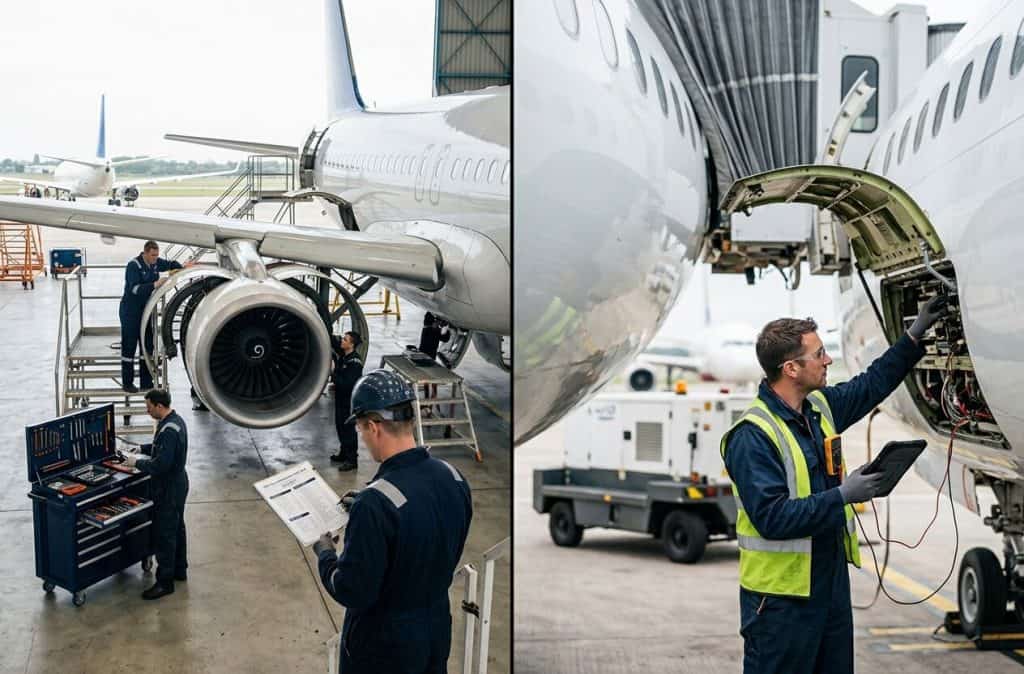
Scheduled maintenance is work planned in advance through an approved maintenance program, carried out at defined intervals regardless of whether a fault exists. Unscheduled maintenance is work triggered by an unplanned event, typically a reported defect, fault message, or damage discovered during operation. Both are essential parts of keeping an aircraft airworthy, but they are managed very differently.
The distinction matters because it shapes how airlines plan aircraft utilization, how CAMO organizations monitor continuing airworthiness, and how maintenance control responds when something goes wrong outside the plan. A well-run maintenance program does not eliminate unscheduled maintenance. It manages the balance between the two.
This article breaks down what separates scheduled from unscheduled maintenance, why unscheduled events happen even on well-maintained aircraft, and how airlines and maintenance organizations handle both without compromising safety.
What Scheduled Aircraft Maintenance Means
Scheduled maintenance refers to maintenance tasks defined in advance within an approved maintenance program and performed at set intervals. These intervals are typically expressed in flight hours, flight cycles, or calendar time, and sometimes a combination of all three.
The maintenance program itself is built from sources such as the manufacturer’s Maintenance Planning Document (MPD), the Maintenance Review Board Report (MRBR), and any additional operator-specific requirements. The operator’s CAMO or the maintenance planning function translates these source documents into a customized maintenance program, which is then approved by the relevant authority as part of the operator’s continuing airworthiness arrangements.
Because scheduled tasks are known well in advance, they can be planned around aircraft rotation, hangar slot availability, spares provisioning, and manpower. This predictability is the defining feature of scheduled maintenance.
What Unscheduled Aircraft Maintenance Means
Unscheduled maintenance is maintenance performed in response to an unplanned event rather than a pre-set interval. It is triggered by something the maintenance program did not anticipate at that specific point in time, such as a reported defect, an abnormal indication, a bird strike, or damage found during a walk-around inspection.
Unscheduled maintenance is not necessarily a sign that something has gone wrong with the aircraft or the maintenance program. Aircraft are complex systems operating in variable environments, and components can fail, degrade, or be damaged in ways that a fixed schedule cannot fully predict.
The key difference from scheduled maintenance is timing and trigger. Scheduled maintenance is initiated by the calendar or the counter. Unscheduled maintenance is initiated by an event.
Key Differences Between Scheduled and Unscheduled Maintenance
| Aspect | Scheduled Maintenance | Unscheduled Maintenance |
|---|---|---|
| Trigger | Predefined interval (flight hours, cycles, calendar time) | Unplanned event (defect, fault, damage) |
| Planning horizon | Weeks to months in advance | Little to no advance notice |
| Source | Maintenance program (MPD, MRBR, operator program) | Pilot report, fault message, inspection finding |
| Typical location | Base maintenance, sometimes line maintenance | Line maintenance, occasionally escalated to base maintenance |
| Resource planning | Parts, tooling, and manpower pre-arranged | Resources mobilized reactively, sometimes under time pressure |
| Operational impact | Built into aircraft rotation and schedule | Can cause delay, cancellation, or aircraft swap if not resolved quickly |
This table reflects general practice. The exact split between what is treated as scheduled versus unscheduled can vary depending on the operator’s maintenance program and the maintenance organization’s procedures.
Common Examples of Scheduled Maintenance
Typical examples of scheduled maintenance include:
- Periodic checks defined by the maintenance program (commonly referred to using letter or number check designations depending on the operator’s program structure)
- Component replacement or overhaul at a defined life limit or interval
- Scheduled structural inspections, including corrosion prevention and control program (CPCP) tasks
- Scheduled lubrication, servicing, and functional checks
- Compliance with recurring Airworthiness Directives (ADs) that specify repetitive inspection intervals
The specific tasks, intervals, and check nomenclature depend entirely on the aircraft type and the operator’s approved maintenance program. None of these should be assumed to apply universally across all aircraft types or operators.
Common Examples of Unscheduled Maintenance
Typical examples of unscheduled maintenance include:
- Rectification of a defect reported by the flight crew in the technical log
- Troubleshooting an intermittent system fault flagged by onboard monitoring
- Repair of damage found during a pre-flight or transit inspection (for example, a ground service equipment strike)
- Replacement of a component that has failed before reaching its scheduled life limit
- Rectification following a bird strike, lightning strike, or hard landing report
Common Causes of Unscheduled Maintenance
Unscheduled maintenance can arise from several distinct causes, and it is useful to separate them rather than treating unscheduled maintenance as a single category of “things going wrong.”
Component or system failure. Parts can fail before their expected service life due to normal statistical failure distribution, manufacturing variability, or operating conditions.
External damage. Bird strikes, lightning strikes, hail, ground equipment contact, and foreign object debris (FOD) all cause damage that could not have been scheduled.
Operational events. Hard landings, tail strikes, overweight landings, and turbulence encounters can trigger mandatory inspections outside the normal program.
Latent or intermittent faults. Some faults do not appear consistently and are only detected through crew reports or fault monitoring systems, requiring troubleshooting rather than a straightforward fix.
Findings during other maintenance. A scheduled check can uncover an unrelated defect, such as corrosion or wear beyond limits, which then becomes an unscheduled task even though it was found during a scheduled event.
How Defects Lead to Unscheduled Maintenance
A defect is any condition where an aircraft, system, or component does not meet its approved configuration or does not function as intended. Defects can be reported by flight crew, identified by cabin crew, found during ground inspections, or flagged automatically by aircraft monitoring systems.
Once a defect is reported, it enters a defined process. Maintenance personnel assess the defect against the Minimum Equipment List (MEL) or Configuration Deviation List (CDL) where applicable, determine whether the aircraft can be dispatched with the defect deferred under specified conditions, or whether rectification is required before further flight.
This is where unscheduled maintenance becomes a coordinated process rather than an ad hoc reaction. Maintenance control, engineering support, and often CAMO are involved in deciding whether to rectify immediately, defer under MEL/CDL provisions, or escalate for further investigation.
How Maintenance Programs Support Scheduled Maintenance
The maintenance program is the framework that makes scheduled maintenance possible. It defines what tasks are required, at what intervals, and under what conditions, based on manufacturer data, operational experience, and regulatory requirements.
A properly functioning maintenance program does more than list tasks. It integrates reliability monitoring, so that if a scheduled interval proves too conservative or too lenient based on in-service data, the program can be escalated or de-escalated through an approved process. This is part of why reliability programs and maintenance programs are closely linked rather than separate concerns.
For a broader explanation of how maintenance programs are structured and approved, see our related article on [Aircraft Maintenance Programs Explained] (future article).
The Role of Troubleshooting and Corrective Action
Troubleshooting is the structured process of identifying the root cause of a defect, typically guided by the aircraft’s Fault Isolation Manual (FIM) or equivalent troubleshooting data. It is a core activity in unscheduled maintenance because a reported symptom does not always point directly to a single failed component.
Corrective maintenance is the action taken to resolve a defect once its cause is identified, such as replacing a faulty component, repairing damage, or adjusting a system. Corrective maintenance is usually associated with unscheduled events, but it is worth noting that corrective action can also follow a finding made during scheduled maintenance, such as replacing a worn part discovered during a scheduled inspection.
Preventive maintenance, by contrast, is maintenance performed specifically to reduce the likelihood of failure before it occurs, and it is generally scheduled by nature, though not exclusively tied to fixed calendar intervals in every maintenance program structure.
Operational Impact of Unscheduled Maintenance
Unscheduled maintenance has a direct effect on flight operations because, unlike scheduled maintenance, it is not built into the aircraft rotation plan. Depending on the nature and severity of the defect, the operational response can range from a minor delay to a full aircraft swap or cancellation.
Airlines typically manage this through a maintenance control function that works alongside operations control to assess the impact on the day’s schedule. If the defect can be deferred under MEL/CDL provisions, the aircraft may continue operating with the defect recorded and rectification scheduled within an allowable time limit. If it cannot be deferred, the aircraft may need to be pulled from service until rectification is complete.
How Airlines Manage Unscheduled Maintenance
Airlines manage unscheduled maintenance through a combination of preparedness and reactive coordination rather than pure improvisation. This includes maintaining spares availability at line stations, having on-call engineering support, and using reliability data to anticipate which systems are more likely to generate unscheduled events.
Maintenance control typically owns the real-time decision-making: assessing the defect, checking MEL/CDL applicability, coordinating with line maintenance or a maintenance organization, and communicating operational impact to flight operations. CAMO plays a broader continuing airworthiness role, particularly when a defect indicates a wider fleet trend or requires engineering assessment beyond routine MEL deferral.
Scheduled vs Unscheduled Maintenance: Practical Comparison
| Aspect | Scheduled Maintenance | Unscheduled Maintenance |
|---|---|---|
| Trigger | Interval defined in the maintenance program | Defect, fault, or damage event |
| Planning | Weeks to months ahead | Reactive, often same day |
| Documentation source | Task cards from the approved maintenance program | Technical log defect entry, fault report |
| Typical setting | Base maintenance, planned line checks | Line maintenance, occasionally escalated to base |
| Deferral possible | Not applicable, task is required by schedule | Often possible under MEL/CDL, subject to conditions |
| Primary coordinating function | Maintenance planning, CAMO | Maintenance control, engineering support |
Preventive vs Corrective Maintenance Compared to Scheduled vs Unscheduled
| Concept | Usually Associated With | Notes |
|---|---|---|
| Preventive maintenance | Scheduled | Performed to reduce failure likelihood before it occurs |
| Corrective maintenance | Unscheduled (mostly) | Can also follow a finding during a scheduled check |
| Scheduled maintenance | Preventive in intent | Not every scheduled task is preventive in the strict sense |
| Unscheduled maintenance | Corrective in most cases | Occasionally includes precautionary action after an event, not strictly a failure |
This distinction matters because scheduled and unscheduled describe timing and trigger, while preventive and corrective describe intent and function. They overlap heavily but are not identical concepts.
Practical Aviation Examples
Scheduled inspection during a planned maintenance visit. An aircraft arrives at a maintenance base for a planned check. Engineers work through pre-issued task cards covering structural inspections, servicing, and component checks. Every task was known in advance, and parts and tooling were arranged before the aircraft arrived.
Component replacement triggered by a known interval. A hydraulic component reaches its defined life limit as tracked by the operator’s maintenance tracking system. It is replaced during a scheduled maintenance event, with the replacement part ordered and staged in advance.
In-service system fault discovered before a flight. During pre-flight checks, an engineer identifies a fault message on the aircraft’s centralized fault display. Troubleshooting per the Fault Isolation Manual is required before the aircraft can be released, making this an unscheduled task discovered on the ground rather than in flight.
Hydraulic leak requiring corrective maintenance. A hydraulic leak is reported after a flight. Line maintenance investigates, identifies the source, and replaces a seal or component. This is corrective maintenance triggered by an unscheduled event.
Repetitive defect requiring troubleshooting. The same fault is reported across several flights without a clear single cause. Engineering support and maintenance control escalate the issue, potentially involving deeper troubleshooting, OEM technical support, or a temporary operational restriction while root cause analysis continues.
Aircraft arriving with an unexpected defect. An aircraft lands with a reported bird strike. Ground inspection determines the extent of damage. Depending on severity, this may require immediate rectification, a temporary repair under an approved process, or grounding until an engineering assessment is completed.
Aviation Perspective
Airline Operations
Scheduled maintenance is built into aircraft rotation planning, so its operational impact is absorbed in advance through spare aircraft allocation, crew planning, and schedule design. Unscheduled maintenance disrupts this plan and can lead to delays, cancellations, or last-minute aircraft swaps, depending on how quickly the defect can be assessed and resolved.
CAMO
CAMO is responsible for the continuing airworthiness of the aircraft, which includes overseeing the maintenance program, monitoring reliability trends, and assessing the airworthiness significance of both scheduled findings and unscheduled defects. When an unscheduled defect suggests a broader issue, such as a recurring fault across the fleet, CAMO engineering staff assess whether the maintenance program itself needs adjustment.
Maintenance Organization
Maintenance organizations execute both scheduled and unscheduled work, but the operational rhythm differs. Scheduled work follows a planned sequence of task cards with predictable resource needs. Unscheduled work requires flexible resourcing, since defects can appear at any station, at any time, with varying complexity.
Maintenance Control
Maintenance control is typically the function that manages real-time unscheduled events, particularly for line operations. This includes assessing MEL/CDL applicability, coordinating rectification resources, deciding whether a defect can be deferred, and communicating the operational impact to flight operations.
Regulatory Perspective
Regulatory frameworks differ in how they structure continuing airworthiness and maintenance program requirements. Under EASA, continuing airworthiness management is addressed through Part-M (or Part-CAMO under more recent regulatory restructuring), and maintenance organization approval is addressed through Part-145. Under the FAA, continuing airworthiness and maintenance program requirements are addressed through parts of Title 14 CFR, with terminology and program structures that differ from EASA’s.
ICAO provides overarching Standards and Recommended Practices, primarily through Annex 6 and Annex 8, which member states implement through their own national regulations. As a result, specific terminology such as check nomenclature, deferral processes, or program approval steps can vary meaningfully between EASA, FAA, UK CAA, Transport Canada, and other national authorities. None of these frameworks should be assumed identical, and operators must follow the specific requirements of their certifying authority and approved maintenance program.
Common Misconceptions
Myth: Scheduled maintenance means the aircraft cannot develop defects.
Reality: Scheduled maintenance reduces the likelihood of certain failures through planned inspections and component replacement, but it cannot eliminate all defects. Components can fail statistically before their expected life, and external events such as bird strikes or lightning strikes are inherently unpredictable.
Myth: Unscheduled maintenance is always caused by poor maintenance.
Reality: Unscheduled maintenance is often the result of normal failure behavior, external damage, or operational events, not maintenance quality issues. A well-maintained aircraft can still generate unscheduled defects, since no maintenance program can predict every possible failure or event.
Myth: Every maintenance task can be cleanly classified as either scheduled or unscheduled.
Reality: Some tasks blur the line, such as a defect found during a scheduled inspection that then requires corrective action, or a repetitive AD-driven inspection that becomes more frequent due to findings. Classification also depends on how the operator’s maintenance program and procedures define these categories.
Myth: Unscheduled maintenance always grounds the aircraft.
Reality: Many defects can be deferred under MEL or CDL provisions, allowing the aircraft to continue operating under specified conditions until rectification is completed within an allowable timeframe. Whether deferral is possible depends on the nature of the defect and the applicable MEL/CDL provisions.
Myth: Preventive maintenance and scheduled maintenance are the same thing.
Reality: Most preventive maintenance is scheduled, but the terms describe different things. Scheduled describes timing and trigger, while preventive describes intent. Some scheduled tasks exist for reasons other than pure failure prevention, such as regulatory compliance inspections.
Frequently Asked Questions
What is scheduled maintenance on an aircraft?
Scheduled maintenance is maintenance performed at predefined intervals set out in an approved maintenance program, based on flight hours, flight cycles, or calendar time, regardless of whether a specific defect exists.
What is unscheduled aircraft maintenance?
Unscheduled maintenance is maintenance triggered by an unplanned event, such as a reported defect, fault indication, or damage, rather than by a fixed interval in the maintenance program.
What is the main difference between scheduled and unscheduled maintenance?
The main difference is the trigger. Scheduled maintenance is initiated by a predefined interval, while unscheduled maintenance is initiated by an unplanned event or defect.
What causes unscheduled aircraft maintenance?
Common causes include component failure before its expected service life, external damage such as bird strikes or lightning strikes, operational events like hard landings, and intermittent faults detected through crew reports or monitoring systems.
Is corrective maintenance always unscheduled?
Not always. Corrective maintenance is most commonly associated with unscheduled events, but it can also follow a finding made during a scheduled inspection, such as replacing a part found worn beyond limits.
Is preventive maintenance always scheduled?
In most maintenance programs, yes, since preventive maintenance is designed around planned intervals intended to reduce failure risk. However, the exact classification can depend on how an operator’s maintenance program is structured.
Does unscheduled maintenance always ground the aircraft?
No. Many defects can be deferred under MEL or CDL provisions, allowing continued operation under specified conditions until rectification is completed within an allowable time limit, provided the defect qualifies for deferral.
Who manages scheduled and unscheduled maintenance in an airline?
Maintenance planning and CAMO generally manage scheduled maintenance, ensuring the maintenance program is followed and continuing airworthiness is maintained. Maintenance control typically manages the real-time response to unscheduled defects, often coordinating with line maintenance or a maintenance organization.
Can a scheduled maintenance check uncover unscheduled work?
Yes. It is common for a scheduled inspection to reveal an unrelated defect, such as corrosion or wear beyond allowable limits, which then requires corrective action outside the original scope of the scheduled task.
Does unscheduled maintenance mean the maintenance program has failed?
Not necessarily. Maintenance programs are designed based on statistical failure behavior and known risks, but they cannot eliminate every possible failure mode or external event. Reliability programs help operators monitor whether unscheduled events indicate a need to adjust the maintenance program.
Conclusion
Scheduled and unscheduled maintenance are not competing systems, they are two sides of the same continuing airworthiness process. Scheduled maintenance provides the predictable backbone that keeps an aircraft’s systems and structure within safe operating limits. Unscheduled maintenance is the mechanism that responds when reality does not follow the plan, whether that means a component failing early or an aircraft picking up damage on the ramp.
An airline’s maintenance system is judged not by whether unscheduled events happen, but by how effectively CAMO, maintenance control, and maintenance organizations coordinate to assess, rectify, or safely defer them. Understanding how these two categories interact, rather than treating them as isolated concepts, gives a much clearer picture of how aircraft are actually kept airworthy day to day.