
Line Maintenance vs Base Maintenance Explained
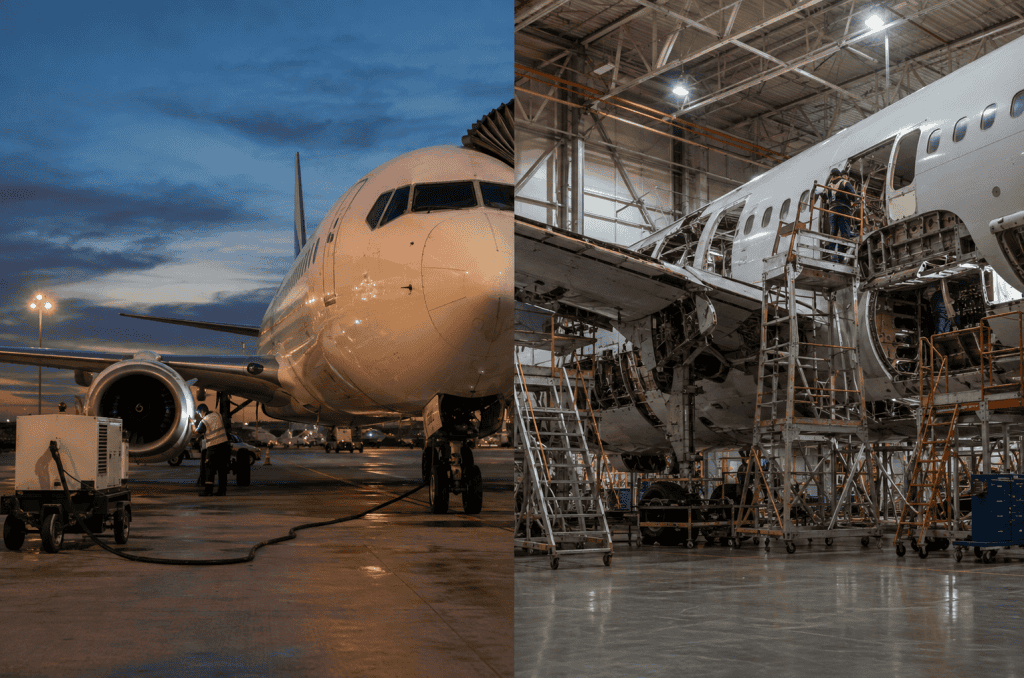
Line maintenance and base maintenance are not defined by how serious the work is. They are defined by where the work happens, how much access it requires, and how it fits into an aircraft’s operating schedule.
Line maintenance covers the checks, troubleshooting, and defect rectification carried out while an aircraft continues flying its normal schedule, using the facilities and approvals available at the airport. Base maintenance covers the more extensive inputs that require a hangar environment, structured access to the airframe, and enough downtime to complete inspections and modifications that cannot be done between flights.
The distinction matters because it shapes how airlines plan aircraft utilization, how CAMOs forecast maintenance inputs, and how maintenance organisations allocate facilities and manpower. It also gets misunderstood often, particularly the assumption that line maintenance means “minor” and base maintenance means “major.” That is not accurate, and this article explains why.
What Is Line Maintenance?
Line maintenance is maintenance performed to keep an aircraft serviceable for its next flight or next few flights, carried out within the approved scope and facilities available at an airport, without requiring the aircraft to go into a maintenance hangar for extended access work.
It includes both scheduled and unscheduled activity.
Scheduled line maintenance covers checks performed at defined intervals or before/after specific numbers of flight cycles or flight hours, such as transit checks, daily checks, and weekly checks. These are visual inspections and functional checks defined in the aircraft’s approved maintenance programme.
Unscheduled line maintenance covers defect rectification and troubleshooting that arise from pilot reports, cabin crew reports, or findings during a scheduled check. If a hydraulic leak is reported after landing, the line maintenance team investigates, identifies the source, and rectifies it if the task is within their approved scope and the required parts and tooling are available.
Typical line maintenance tasks include:
- Transit checks between flights
- Daily and weekly checks
- Defect troubleshooting and rectification
- Component replacement within approved line scope (batteries, tires, brake units, certain avionics line-replaceable units)
- Servicing (oil, hydraulic fluid, oxygen, potable water)
- Minor repairs permitted under the applicable structural repair manual or maintenance manual, within line capability
It is a mistake to define line maintenance simply as “minor maintenance.” Some line stations, particularly at major hub airports with strong facilities and highly qualified engineers, are approved to replace major components such as engines or landing gear if the maintenance organisation holds the appropriate rating and the task does not require hangar access. The defining factor is not the size of the task but whether it can be performed within the approved line environment and without extended aircraft downtime.
What Is Base Maintenance?
Base maintenance refers to maintenance inputs performed in a hangar environment, typically involving more extensive inspection, access, and downtime than line maintenance allows.
It usually includes:
- Structural inspections requiring removal of interior panels, floor boards, or fuselage skin access panels
- Detailed system inspections that require extended aircraft downtime
- Corrosion inspections
- Non-destructive testing
- Major modifications and service bulletin embodiment
- Painting and major cosmetic work
- Component replacements that require hangar facilities, cranes, or extended access
Base maintenance requires more time, manpower, facilities, and planning for several practical reasons. Structural inspections often require opening large sections of the aircraft, which takes hours or days of preparation and reassembly. Some tasks require specific ambient conditions, lighting, or access equipment only available in a hangar. Others require multiple trades working in sequence, such as structures, avionics, and cabin teams, which needs coordinated scheduling.
It is also inaccurate to assume every base maintenance task is automatically “major.” A short hangar visit for a single structural inspection combined with a few open work-package items can still be classified as base maintenance, even though the individual tasks are limited in scope. What makes it base maintenance is the environment and access requirement, not necessarily the complexity of every task inside the package.
Line Maintenance vs Base Maintenance: Key Differences
| Factor | Line Maintenance | Base Maintenance |
|---|---|---|
| Typical location | Airport ramp, gate, or line station | Maintenance hangar |
| Typical duration | Minutes to a few hours | Days to several weeks, depending on scope |
| Work scope | Checks, servicing, defect rectification within line approval | Structural, system, and extended inspections within hangar approval |
| Aircraft availability | Aircraft generally remains in operational schedule | Aircraft is removed from schedule for the input |
| Access requirements | Limited access, mostly external and accessible panels | Extended access, interior panels, structure, sometimes engine or gear removal |
| Facilities | Line stand, gate, apron equipment | Hangar, access stands, specialised tooling |
| Manpower | Smaller teams, often multi-skilled | Larger teams across multiple trades |
| Tooling | Portable and line-approved tooling | Hangar-based equipment, cranes, jacks, specialised rigs |
| Scheduled work | Transit, daily, weekly checks | Heavier scheduled inspections, structural checks |
| Unscheduled work | Defect rectification, troubleshooting | Findings from base inspections requiring repair |
| Defect rectification | Common and frequent | Occurs but often as part of a planned package |
| Heavy inspections | Not typically performed here | Core purpose of base maintenance |
| Operational impact | Minimal, built into turnaround time | Aircraft removed from revenue service |
| Planning requirements | Short-term, reactive and routine | Long-term, forecasted well in advance |
Note that the specific boundary in each row depends on the operator’s approved maintenance programme, the maintenance organisation’s approvals, and the aircraft type. Practices vary between airlines and between regulatory systems.
Where Do Transit Checks, A-Checks and C-Checks Fit?
This is where most confusion happens, so it is worth being precise.
Transit checks are quick visual inspections performed between flights, usually by line maintenance personnel or, on some aircraft types and under certain operator procedures, by qualified flight crew. They check for obvious damage, fluid leaks, tire condition, and general external condition.
Daily and weekly checks are more detailed than transit checks and are performed at defined intervals, again generally handled by line maintenance.
A-checks are scheduled maintenance events defined in the aircraft’s approved maintenance programme, typically covering system checks, lubrication, and functional tests at intervals measured in flight hours or cycles. Many operators perform A-checks within line maintenance capability, sometimes overnight at a base station. However, this is not universal. Some operators, depending on aircraft type, maintenance programme design, and organisational structure, classify A-checks or combine them with hangar visits, which shifts them toward a base maintenance environment.
C-checks are significantly more extensive scheduled maintenance events that almost always require hangar access due to the volume of access, inspection, and testing involved. For this reason, C-checks are typically associated with base maintenance. But even here, the exact scope, duration, and classification depend on the maintenance programme approved for that aircraft and operator.
The table below summarises typical association, while acknowledging that exceptions exist.
| Check Type | Typical Association | Key Qualifier |
|---|---|---|
| Transit check | Line maintenance | Performed between flights, scope varies by operator |
| Daily/weekly check | Line maintenance | Interval and scope defined in maintenance programme |
| A-check | Usually line maintenance | Some operators or aircraft types require hangar access |
| C-check | Usually base maintenance | Scope and duration vary by aircraft type and programme |
| Heavier structural inputs | Base maintenance | Requires extended hangar access, near universally |
The takeaway is straightforward. A-check does not automatically mean line maintenance, and C-check does not automatically mean base maintenance. What determines the classification is the approved maintenance programme, the facilities required, and the operator’s own procedures, not a fixed industry-wide rule.
Examples: What Happens During Line vs Base Maintenance?
Scenario 1: Aircraft arrives with a reported defect
A pilot reports a fuel quantity indication discrepancy on arrival. The line maintenance engineer reviews the technical log, consults the aircraft maintenance manual troubleshooting procedure, checks the relevant sensor or wiring using approved test equipment, and either rectifies the fault or defers it under the minimum equipment list if permitted. If the fault requires replacing a fuel quantity processing unit that is line-replaceable and available at that station, the aircraft can often be released back into service without going to a hangar.
Scenario 2: Scheduled heavier inspection
An aircraft reaches the interval defined in its maintenance programme for a detailed wing structural inspection requiring removal of access panels and use of non-destructive testing equipment. This cannot be completed at the gate in the time available between flights. The aircraft is routed to base maintenance, where the inspection, any resulting repairs, and other scheduled tasks are packaged into a single hangar visit.
Scenario 3: Component replacement
A main landing gear tire replacement is a routine line maintenance task, completed at the gate within the turnaround window. A landing gear leg replacement, by contrast, generally requires jacking the aircraft, specific tooling, and more time, which is often planned into a base maintenance visit, although some operators with strong line capability and appropriate approvals may accomplish it at an outstation if facilities allow. The task itself is similar in nature, but the environment required depends on the organisation’s approved scope and the specific circumstances.
Scenario 4: Aircraft scheduled for a major maintenance input
An aircraft is due for a heavier scheduled maintenance package combining structural inspections, cabin refurbishment, and multiple service bulletin embodiments. CAMO forecasts this input months in advance, coordinates with the maintenance organisation on slot availability, and the airline adjusts its flight schedule to remove the aircraft from service for the planned duration. This requires far more lead time than any single line maintenance task.
Who Is Responsible for What?
Airline / Operator
The operator holds the air operator certificate and is ultimately responsible for ensuring its aircraft remain airworthy, though the practical execution of that responsibility is shared across CAMO and approved maintenance organisations depending on the regulatory framework.
CAMO
The continuing airworthiness management organisation manages the aircraft’s maintenance programme, forecasts due maintenance tasks, and ensures maintenance is planned and contracted appropriately. CAMO does not typically perform the physical maintenance itself. Its role is airworthiness management and planning oversight.
Approved Maintenance Organisation
The AMO physically performs the maintenance, whether line or base, under its own approval and scope of work. This may be the operator’s in-house maintenance organisation or a contracted third-party MRO.
Maintenance Planning
Maintenance planning, whether within CAMO or a dedicated planning function, translates the maintenance programme into scheduled inputs, allocates due tasks to upcoming line or base visits, and manages the due-list.
Certifying Staff
Certifying staff, holding the appropriate authorisation under the applicable regulatory system, release the aircraft to service after maintenance is completed, confirming the work was performed correctly and the aircraft meets its approved configuration and airworthiness requirements.
Production Planning / Maintenance Control
Within the AMO, production planning and maintenance control coordinate the practical execution of work packages, manpower allocation, and shift scheduling, particularly for base maintenance inputs involving multiple trades.
The exact division of responsibility, particularly around who holds which approval and what privileges certifying staff have, depends on the applicable regulatory framework. EASA, FAA, and other national systems structure these responsibilities differently, so operators and engineers should verify specifics against their own approved organisation exposition and the applicable regulation.
Why the Difference Matters to an Airline
The line and base maintenance distinction directly affects how an airline plans its operation.
Line maintenance is built into the operating schedule. Turnaround times account for transit checks and typical defect rectification, so this work has minimal impact on aircraft availability as long as defects are resolved within the scheduled ground time.
Base maintenance removes an aircraft from revenue service entirely. Airlines must plan around this well in advance, factoring the aircraft into their fleet utilization models so enough aircraft remain available to cover the schedule while one or more aircraft are in the hangar.
This affects several operational areas:
- Hangar planning: Airlines with their own maintenance capability must schedule hangar slots months ahead, particularly for larger fleets.
- Manpower: Base maintenance requires larger, often specialised teams; line maintenance requires broader geographic coverage with smaller teams at each station.
- Spare parts: Base inputs often require pre-positioning parts based on expected findings, while line maintenance relies on readily available line-replaceable units at each station.
- MRO contracts: Airlines without in-house base maintenance capability contract MROs, which requires slot booking and contract management well ahead of the input.
- Aircraft utilization: Every base maintenance input reduces the aircraft’s available flying days for that period, which must be reflected in the flight schedule.
- Cost: Base maintenance inputs typically represent significant planned expenditure, whereas line maintenance cost is distributed across daily operations.
Getting this planning wrong leads to real operational consequences, including flight cancellations, schedule disruption, or unplanned aircraft on ground situations.
CAMO Perspective
From a CAMO perspective, the line versus base maintenance distinction is primarily a planning and forecasting exercise.
CAMO maintains the maintenance programme and tracks the due status of every scheduled task, whether it belongs in a routine line check or a base maintenance package. This due-list management determines when an aircraft needs to visit the hangar and what tasks should be bundled into that visit to minimise downtime and avoid repeated inputs for related work.
Work package development for a base maintenance input typically starts well ahead of the actual date, incorporating due inspections, open service bulletins, deferred defects that require hangar access, and any modification embodiments planned for that aircraft.
CAMO also manages defect control, tracking which reported defects have been rectified through line maintenance and which have been deferred under the minimum equipment list pending a base maintenance opportunity. This keeps the aircraft’s technical records accurate and ensures no deferred item is overlooked when planning the next hangar visit.
Coordination with the AMO is continuous. CAMO communicates the forecast, the AMO confirms capacity and scope of approval, and both sides align on scheduling. This relationship works differently depending on whether the AMO is in-house or a contracted external organisation, but the fundamental planning role of CAMO remains the same across both models.
Common Misconceptions About Line and Base Maintenance
Myth: Line maintenance is only minor maintenance.
Reality: Line maintenance can include significant component replacements, provided the task is within the approved line scope and does not require hangar access. The classification depends on environment and access requirements, not task complexity.
Myth: Base maintenance always means a C-check.
Reality: Base maintenance covers any hangar-based input, which can include isolated structural inspections, modification packages, or combinations of smaller tasks that simply require hangar access. Not every hangar visit is a full C-check.
Myth: Every A-check is line maintenance.
Reality: Many operators perform A-checks within line capability, but this depends on the aircraft’s maintenance programme and the operator’s procedures. Some A-checks, particularly on certain aircraft types or combined with other tasks, require hangar access.
Myth: A component replacement always happens in the same maintenance environment regardless of the aircraft.
Reality: The environment required for a given task depends on the maintenance organisation’s approved scope, available tooling, and the specific aircraft configuration, not a fixed universal rule for that component type.
Myth: All airlines define line and base maintenance identically.
Reality: Definitions and boundaries are shaped by each operator’s approved maintenance programme and organisational structure, so practices can differ meaningfully between airlines and aircraft types.
Myth: Base maintenance is always more expensive per task than line maintenance.
Reality: Base maintenance inputs generally cost more in total due to scale and downtime, but individual task cost depends on the specific work involved, not simply which environment it occurs in.
Frequently Asked Questions
What is the difference between line maintenance and base maintenance? Line maintenance is performed at the airport, typically without removing the aircraft from its operating schedule for extended periods, while base maintenance requires a hangar environment and dedicated aircraft downtime for more extensive access and inspection.
Is line maintenance the same as routine maintenance? Not exactly. Line maintenance includes routine checks like transit and daily checks, but also covers unscheduled defect rectification, which is not routine.
Is base maintenance the same as heavy maintenance? The terms are often used interchangeably, though base maintenance specifically refers to the hangar environment, while heavy maintenance more often describes the scale and depth of the inspection package.
Is an A-check line maintenance? Often, but not always. It depends on the aircraft type, the approved maintenance programme, and the operator’s procedures.
Is a C-check base maintenance? Typically yes, since C-checks generally require hangar access, but the exact scope and duration vary by aircraft type and maintenance programme.
Can major component replacement be performed during line maintenance? Yes, if the task is within the maintenance organisation’s approved line scope and does not require hangar facilities or extended access.
Who performs line and base maintenance? Approved maintenance organisations perform both, either through in-house maintenance capability or contracted line and base maintenance providers.
Why do aircraft need base maintenance? Certain inspections, structural checks, and modifications require extended access and time that cannot be accommodated within normal flight turnaround schedules.
How does CAMO interact with line and base maintenance? CAMO forecasts due maintenance, develops work packages, and coordinates with the maintenance organisation, but does not perform the physical maintenance itself.
Does every airline define line and base maintenance in exactly the same way? No. Boundaries depend on each operator’s approved maintenance programme, aircraft type, and organisational capability, so practices vary across the industry.
Conclusion
Line maintenance generally supports aircraft operation through routine, scheduled, and defect-related maintenance performed within an approved scope at the airport, while base maintenance supports more extensive inputs that require hangar access, greater facilities, and planned aircraft downtime.
The exact boundary between the two is not fixed. It depends on the approved maintenance programme, the aircraft type, the maintenance organisation’s capability, and the applicable regulatory framework. Engineers and CAMO personnel who understand this nuance are better positioned to plan maintenance realistically rather than relying on oversimplified rules that do not hold up across different aircraft types and operators.