
What Is CAMO in Aviation? A Beginner’s Guide
Imagine you own a car, but instead of taking it to the garage yourself whenever something feels off, you have a dedicated team whose only job is to track every part of that car’s life. They know when the oil needs changing, when a recall applies to your model, when a part is approaching its replacement limit, and they keep a complete written history of everything that has ever been done to it. You never have to remember any of it. They do.
Now scale that up to a Boeing 737, an Airbus A330, or an ATR 72, flying multiple sectors a day, carrying hundreds of passengers, and subject to strict international safety law. That tracking team is not optional. It is a legal requirement. And in aviation, that team is called CAMO.
So, what is CAMO in aviation? CAMO stands for Continuing Airworthiness Management Organisation. It is the part of an airline’s technical structure responsible for making sure an aircraft remains legally and technically fit to fly, from the day it’s delivered to the day it’s retired. If you are new to aviation and wondering how airlines actually keep their fleets safe over years of operation, understanding CAMO is one of the best places to start.
What Is CAMO?
The CAMO full form, Continuing Airworthiness Management Organisation, actually explains most of what it does if you break the phrase down.
“Continuing airworthiness” simply means an aircraft stays legally safe to operate throughout its entire operational life, not just when it rolls out of the factory. “Management” means someone is actively planning, tracking, and controlling that process. “Organisation” means it is a formal, approved structure within or connected to an airline, not just one person’s responsibility.
Here’s a simple analogy. Think of an aircraft like a large hospital patient on long-term care. The surgeons and nurses who physically treat the patient are like the maintenance organization, the mechanics who turn wrenches and replace parts. But someone still has to manage the treatment plan: schedule the checkups, track test results, flag when a specialist is needed, and keep the full medical file up to date. That coordinating role, the one managing the plan rather than performing the surgery, is what CAMO does for an aircraft.
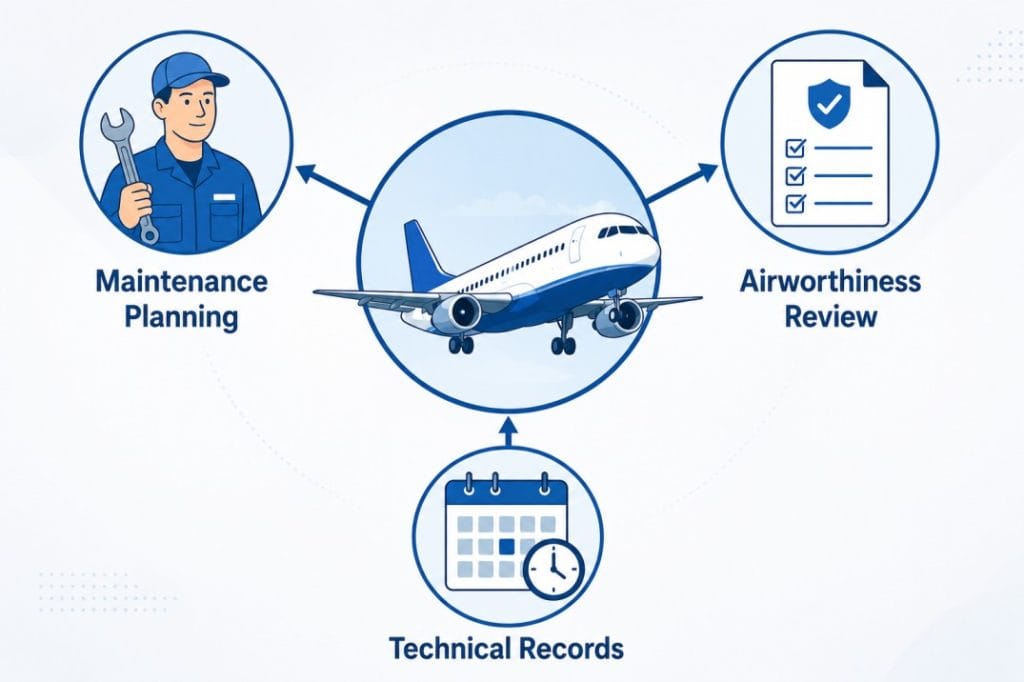
In short, CAMO meaning in aviation comes down to this: it is the organisation that manages the ongoing airworthiness of an aircraft, coordinating maintenance planning and airworthiness management without physically carrying out the repairs itself.
Why Was CAMO Created?
Aviation safety wasn’t always this structured. Decades ago, maintenance decisions were often left entirely to individual airlines or maintenance shops, with far less standardized oversight. As commercial aviation grew and accidents were investigated, regulators realized that airworthiness needed to be actively and continuously managed, not just checked once during certification.
This is where continuing airworthiness regulations come in. Authorities such as EASA in Europe and the FAA in the United States developed detailed rules requiring operators to have a structured system for maintaining airworthiness throughout an aircraft’s life. In the EASA world, this is formalized under Part-M and Part-CAMO regulations.
The reasoning is straightforward. An aircraft is only as safe as its maintenance history and its compliance record. Without a dedicated function tracking every inspection, directive, repair, and modification, small issues can be missed, documentation can fall out of date, and safety margins can quietly erode over years of operation. CAMO exists to prevent exactly that kind of gradual, undetected decline.
What Does CAMO Actually Do?
CAMO’s responsibilities go far beyond paperwork. It touches almost every part of how an aircraft is kept flying safely and legally.
Maintenance Planning
Every aircraft comes with an approved maintenance program, a detailed schedule listing when specific checks and part replacements are due, based on flight hours, flight cycles, or calendar time. CAMO manages this program, forecasting when each aircraft in the fleet will be due for maintenance and coordinating with planning teams so the aircraft is available for that work at the right time, without disrupting flight schedules unnecessarily.
Airworthiness Review
Periodically, an aircraft’s full technical status needs to be formally reviewed to confirm it still meets its certification requirements. This is called an Airworthiness Review, and it results in an Airworthiness Review Certificate, a document confirming the aircraft is legally fit to fly for another defined period. CAMO staff, specifically trained and authorized airworthiness review staff, carry out this review.
Compliance with Airworthiness Directives
An Airworthiness Directive, or AD, is a mandatory instruction issued by a regulatory authority when a safety concern is identified with a particular aircraft type or component. For example, if a manufacturer discovers a fatigue crack risk in a certain wing structure after a number of years in service, the regulator may issue an AD requiring inspection or modification within a specific timeframe. CAMO is responsible for tracking every applicable AD, confirming when and how it must be complied with, and ensuring it gets scheduled into maintenance before the deadline.
Reliability Monitoring
CAMO tracks how aircraft systems and components are actually performing in service, not just what the manual says should happen. If a particular component starts failing more often than expected across the fleet, reliability monitoring flags this early, allowing engineers to investigate before it becomes a bigger issue. This is a core part of aircraft safety management, catching problems through data rather than waiting for them to escalate.
Defect Monitoring
When pilots or engineers report a technical defect, CAMO tracks it through to resolution. This includes deciding whether a defect can be deferred under an approved list of allowable deficiencies, and if so, for how long, before it must be permanently corrected.
Technical Records Management
Every maintenance action, repair, inspection, and part replacement has to be documented and retained. CAMO oversees this technical records management, ensuring the aircraft’s full history is accurate, complete, and available whenever it’s needed, including during audits, lease returns, or sale of the aircraft.
Modification and Repair Management
When an aircraft needs a non-standard repair or a modification, CAMO manages the engineering approval process, working with Design Organisation Approval, DOA, holders or the original manufacturer to make sure the change is properly approved before it’s carried out.
Aircraft Configuration Control
An aircraft’s configuration, its exact combination of installed parts, modifications, and software standards, has to be tracked precisely. CAMO maintains this configuration control so that every maintenance action is carried out against the correct, current baseline.
Coordination with Maintenance Organizations
CAMO does not perform maintenance itself. Instead, it works closely with Line Maintenance for quick daily checks and minor defect rectification, Base Maintenance for scheduled heavy checks, and external MROs, Maintenance, Repair and Organisation providers, when work is outsourced. CAMO defines what needs to be done and when; the maintenance organization physically does the work and certifies it complete.
CAMO vs Aircraft Maintenance
One of the most common points of confusion for beginners is separating CAMO from the maintenance organization that actually works on the aircraft. They are closely linked but legally distinct functions.
| Aspect | CAMO | Maintenance Organization |
|---|---|---|
| Main responsibility | Manage continuing airworthiness | Physically perform maintenance |
| Performs maintenance? | No | Yes |
| Plans maintenance? | Yes | Follows the plan provided by CAMO |
| Certifies maintenance? | No, reviews and accepts certification | Yes, issues certificate of release to service |
| Keeps records? | Yes, overall technical records | Yes, records specific to work performed |
| Regulatory role | Approved under continuing airworthiness regulations | Approved as a maintenance organization, for example Part-145 |
In simple terms, CAMO decides what needs to happen and when, and confirms the aircraft remains airworthy overall. The maintenance organization is the one with hands on the aircraft, doing the physical work and issuing the certification that the specific task was completed correctly.
Who Needs CAMO?
Continuing airworthiness management isn’t limited to major airlines. It applies broadly across commercial and, in many cases, private aviation, though the exact requirements vary depending on the aviation authority and the category of operation.
Commercial airlines operating passenger or cargo aircraft are required to have an approved CAMO, either as an internal department or through a contracted external CAMO provider. Aircraft leasing companies also rely on CAMO oversight, since they need continuing airworthiness properly managed even when the aircraft is operated by someone else. Business aviation operators, running corporate jets, typically fall under similar continuing airworthiness requirements, and some private operators of larger or more complex aircraft are required to have CAMO arrangements in place as well.
The specific regulatory framework differs between authorities, EASA’s Part-CAMO structure is not identical to FAA requirements, for instance, but the underlying principle is consistent worldwide: an aircraft’s airworthiness has to be actively managed, not just assumed.
How CAMO Helps Keep Aircraft Safe
Here’s a practical example. Suppose an aircraft component has a maintenance task due at 20,000 flight hours, say, an inspection of a structural fitting.
CAMO tracks the aircraft’s accumulated flight hours and forecasts, well in advance, when it will reach that 20,000-hour threshold. It coordinates with maintenance planning to schedule the aircraft into a maintenance slot before that limit is reached, factoring in the aircraft’s flight schedule so operational disruption is minimized. Once the inspection is complete, CAMO reviews the maintenance organization’s findings and certification, updates the technical records to reflect the work performed, and confirms the aircraft’s airworthiness status is current.
If the inspection reveals a finding, say, early signs of wear, CAMO also manages the follow-up: engaging with the OEM or DOA holder if an engineering assessment is needed, and ensuring any resulting repair or modification is properly approved and incorporated into the aircraft’s records before it returns to service.
Without this active oversight, a task like this could be missed, delayed past its limit, or completed without a clear audit trail. CAMO exists specifically to make sure that doesn’t happen.
Common Misconceptions About CAMO
Because CAMO’s role is coordinating rather than physically fixing aircraft, it’s often misunderstood. A few common myths are worth clearing up.
| Myth | Fact |
|---|---|
| CAMO repairs aircraft. | CAMO does not perform repairs. Maintenance organizations, such as Line or Base Maintenance and MROs, carry out the physical work. |
| CAMO is only paperwork. | Documentation is one part of the job, but CAMO also manages planning, reliability monitoring, defect tracking, and engineering coordination. It’s an active safety function, not a filing exercise. |
| Pilots decide maintenance schedules. | Pilots report defects and observations, but maintenance scheduling is managed by CAMO using an approved maintenance program, not decided by flight crew. |
Frequently Asked Questions
What is CAMO in aviation? CAMO stands for Continuing Airworthiness Management Organisation. It’s the function responsible for managing an aircraft’s ongoing airworthiness throughout its operational life, including maintenance planning, compliance, and technical records.
What does CAMO stand for? Continuing Airworthiness Management Organisation.
What is the difference between CAMO and an MRO? CAMO plans and manages airworthiness requirements. An MRO, Maintenance, Repair and Organisation provider, physically performs the maintenance and repair work that CAMO schedules.
Who approves CAMO? CAMO organizations are approved by the relevant national or regional aviation authority, such as EASA in Europe, based on continuing airworthiness regulations like Part-CAMO.
Does every airline have a CAMO? Commercial airlines are generally required to have an approved CAMO function, either as an internal department or through a contracted external provider.
Can CAMO perform maintenance? No. CAMO manages and oversees airworthiness but does not physically carry out maintenance tasks itself.
Is CAMO required worldwide? The specific term and regulatory structure vary by country and authority, but the underlying requirement for continuing airworthiness management exists in most major aviation regulatory systems worldwide, including under EASA, and equivalent frameworks elsewhere.
Can a CAMO exist independently of an airline? Yes. Some CAMOs operate as independent, approved organizations that provide continuing airworthiness management services to airlines, lessors, or private operators under contract.
Conclusion
So, what is CAMO in aviation, in plain terms? It’s the organisation responsible for continuing airworthiness management, the ongoing process of keeping an aircraft legally and technically fit to fly, year after year, flight after flight. CAMO plans maintenance, tracks compliance, manages records, and coordinates with maintenance organizations, but it doesn’t pick up a wrench itself.
That distinction matters. It’s the difference between an aircraft that simply gets fixed when something breaks, and one whose entire technical life is actively managed to prevent problems before they happen. That’s why CAMO sits at the center of aviation safety, quietly making sure every aircraft you board has been properly looked after long before it ever reaches the runway.