
✈️ Why Pilots File NOTAMs: A Beginner’s Guide
Imagine you’re a pilot preparing for takeoff. The sky is clear, your aircraft is ready, but as you approach your destination, you find out the runway is closed. Now what?
This is exactly the kind of situation that NOTAMs are designed to prevent.
In this beginner’s guide, we’ll break down what NOTAMs are, why pilots file or read them, and how they play a critical role in keeping aviation safe, efficient, and predictable. Whether you’re an aviation enthusiast, student pilot, or just curious, you’ll walk away with a clear understanding of this vital piece of the aviation puzzle.
📌 What Is a NOTAM?
NOTAM stands for Notice to Air Missions. These are official notifications issued by aviation authorities to alert pilots of temporary or time-sensitive information that could affect their flight.
Until recently, NOTAM stood for “Notice to Airmen,” but in a move toward inclusive language, the term has been updated. Despite the name change, the purpose remains the same: inform pilots of critical safety updates before or during a flight.
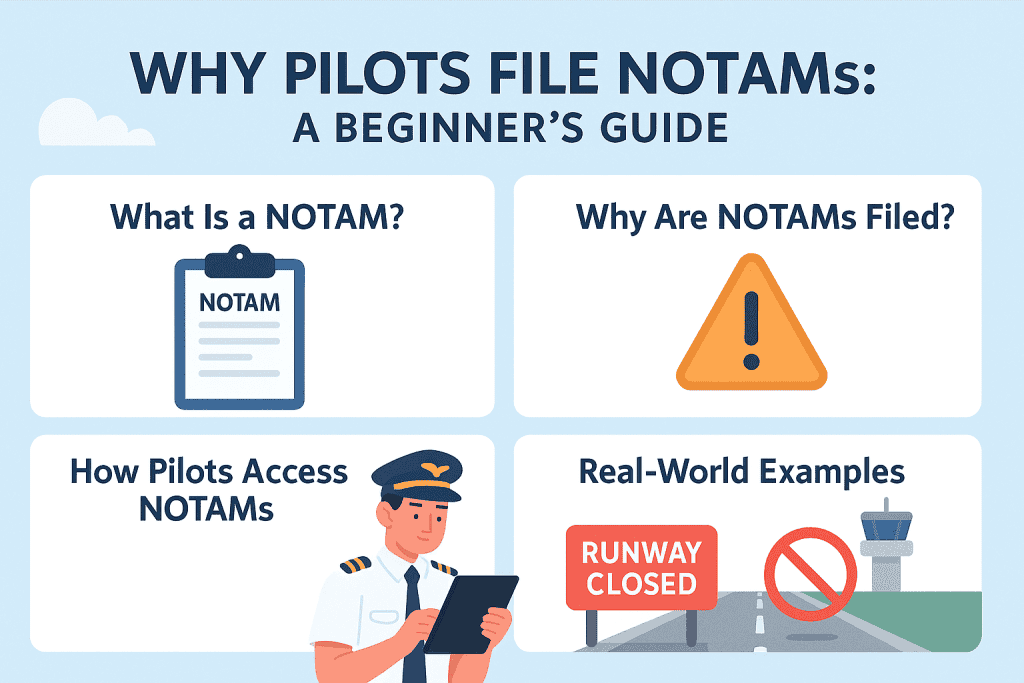
🎯 Why Are NOTAMs Filed?
Pilots, airport authorities, or air traffic control may file NOTAMs to share real-time changes that aren’t reflected in charts or manuals. Here’s why they’re so important:
- Ensure safety by alerting pilots about new hazards.
- Provide updates on temporary changes to airport or airspace infrastructure.
- Prevent delays or diversions due to unexpected closures or limitations.
- Share essential information such as obstacles, equipment outages, or restricted airspace.
✈️ Real-life example:
A pilot files a NOTAM after spotting a flock of birds regularly gathering near a runway—this helps warn other aircraft and may prompt wildlife control measures.
📋 What Kind of Information Do NOTAMs Include?
NOTAMs can cover a wide range of issues. Some of the most common include:
| Type of Information | Example |
|---|---|
| Runway/taxiway closures | “Runway 09/27 closed due to maintenance” |
| Navigation aid outages | “ILS for RWY 14 is unserviceable” |
| Obstacles | “New crane 300 ft AGL 1NM east of airport” |
| Airspace restrictions | “Temporary flight restriction (TFR) over city due to VIP movement” |
| Lighting failures | “Taxiway lights inoperative at night” |
These notices are temporary but critical—often the difference between a safe landing and a near miss.
🧭 Who Issues and Files NOTAMs?
NOTAMs are issued by aviation authorities like the FAA, EASA, or ICAO member states, and may be filed by:
- Airport authorities
- Air traffic controllers
- Pilots and airline dispatchers, in certain situations (e.g., to report hazards)
Filing a NOTAM is part of aviation’s collaborative safety network—it keeps everyone in the loop.
📱 Where Do Pilots Access NOTAMs?
Modern technology makes NOTAMs easy to access. Pilots retrieve them during pre-flight briefings using:
- Flight planning software (e.g., ForeFlight, SkyVector, Garmin Pilot)
- Government portals (e.g., FAA NOTAM Search, EASA EAD)
- Briefing packages provided by dispatch or flight operations
These tools often decode the dense, capitalized text into easier-to-understand messages.
🔍 How Do Pilots Read a NOTAM?
NOTAMs follow a standardized but compact format. Here’s a quick breakdown:
Raw NOTAM:
RWY 09/27 CLSD 2506010800-2506011200Decoded:
- RWY 09/27 = Runway 09/27
- CLSD = Closed
- Dates = From June 1, 2025, 08:00 to 12:00 UTC
Because of the heavy use of abbreviations and capital letters, they can be confusing—especially for new pilots. Fortunately, apps and decoding websites make it easier than ever.
💡 Real-World Examples of NOTAMs in Action
- 2023 FAA NOTAM System Outage: Thousands of U.S. flights were delayed when the system delivering NOTAMs went down—proving just how essential these alerts are.
- Runway Incursion Avoided: A student pilot was about to take off when they checked a NOTAM about a closed taxiway. A quick review likely prevented a dangerous incursion.
These examples show that NOTAMs aren’t just paperwork—they’re life-saving messages.
❌ Common Misconceptions About NOTAMs
| Myth | Reality |
|---|---|
| “They’re optional” | Reviewing NOTAMs is a legal requirement before every flight. |
| “Only ATC needs them” | Pilots are directly responsible for checking them. |
| “They rarely matter” | A single NOTAM can drastically affect your flight path or safety. |
🎓 Why Student Pilots Must Pay Attention
For student pilots, understanding NOTAMs is a core part of training. Even for short local flights, failing to check NOTAMs could result in:
- Landing on a closed runway
- Entering restricted airspace
- Missing important navigational updates
Tip: Start by reading decoded NOTAMs and gradually build confidence interpreting raw formats.
🔄 Think of NOTAMs Like This…
To make it easier to grasp, consider these analogies:
- Google Maps traffic alerts: Real-time updates about road closures and hazards
- Temporary construction signs: Letting you know the road—or in this case, runway—is under repair
- Group text between pilots: An official way to pass important “Watch out!” messages
📦 Quick Tools and Resources
✅ How to Read a NOTAM in 5 Steps:
- Identify the affected airport or airspace.
- Decode abbreviations using a reference or app.
- Read the time and date range (usually in UTC).
- Understand what’s being affected (runway, airspace, lighting).
- Assess whether it impacts your flight.
🔗 Tools to Explore:
- FAA NOTAM Search
- [ICAO NOTAM Decoder Tool (various websites)]
- [ForeFlight NOTAM Browser]
- [SkyVector Flight Planning Tool]
💬 FAQs
Q: Are NOTAMs only for commercial pilots?
No. All pilots—from recreational flyers to airline captains—are responsible for checking NOTAMs.
Q: How often are NOTAMs updated?
They can be issued or modified at any time, 24/7.
Q: Can NOTAMs be wrong?
Occasionally. But errors are rare, and cancellations or corrections are promptly issued.
✈️ Final Thoughts
NOTAMs may not be glamorous, but they are essential to safe flying. They bridge the gap between what’s printed on a chart and what’s actually happening in the air or on the ground—right now.
Whether you’re learning to fly or just diving into the world of aviation, understanding NOTAMs is one of the most practical steps you can take toward aviation literacy.
✈️ Your challenge: Check the NOTAMs for your nearest airport today using an online tool. You might be surprised by what you find.