
⛔️ What Is Restricted Airspace in Aviation? A Simple Guide for Beginners
Not all skies are free to fly in.
Whether you’re a seasoned pilot, a drone enthusiast, or just an aviation geek, you’ve probably heard the term “restricted airspace”. But what does it actually mean? And why are some parts of the sky off-limits?
In this article, I’ll break down what restricted airspace is, how it works, who controls it, and what happens if someone enters it without permission. You’ll also learn how pilots and drone operators stay clear of these invisible barriers in the sky.
✈️ What Is Restricted Airspace?
Restricted airspace refers to a portion of the airspace where flight operations are limited due to potentially hazardous activities. These areas are typically designated for military training, weapons testing, or other sensitive operations that could pose a danger to civilian or commercial aircraft.
Although it’s not entirely prohibited, entry into restricted airspace requires special authorization. If you fly into one of these zones without permission, you could face serious consequences—from interception by military aircraft to hefty fines or license suspension.
Restricted airspace is classified by aviation authorities such as the FAA (in the U.S.) or ICAO (internationally). Each restricted area has its own ID code, altitude range, and active hours.
📍 Example: R-2515 is a restricted area in California used for weapons testing near Edwards Air Force Base.
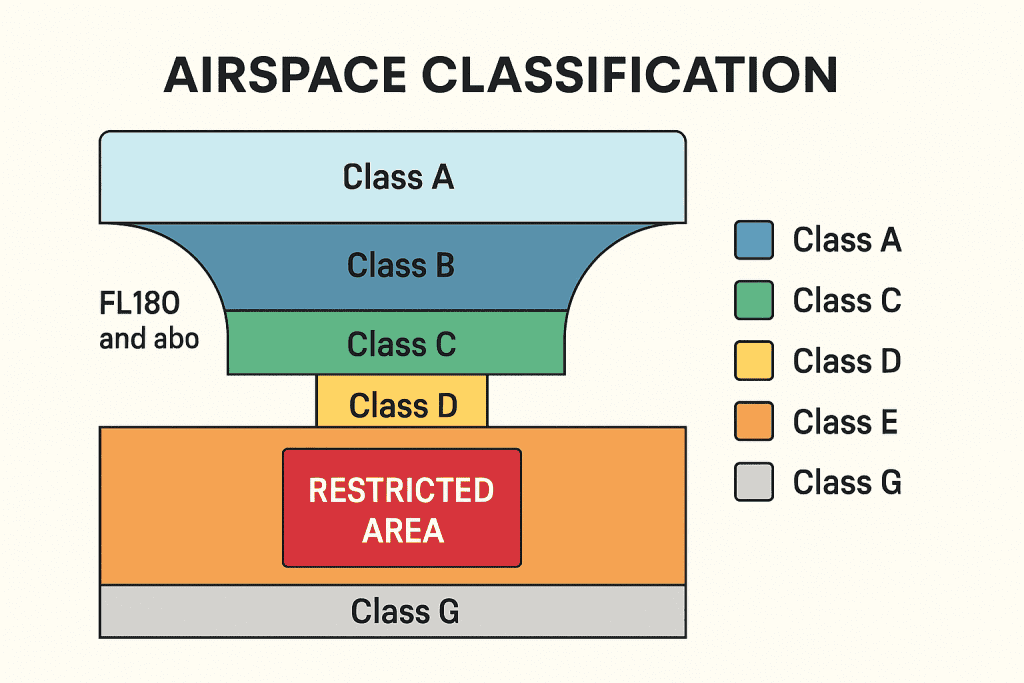
🔄 Restricted vs. Other Types of Airspace: What’s the Difference?
Airspace isn’t just divided into controlled and uncontrolled zones. It’s also classified by what kind of activities are allowed—or not allowed.
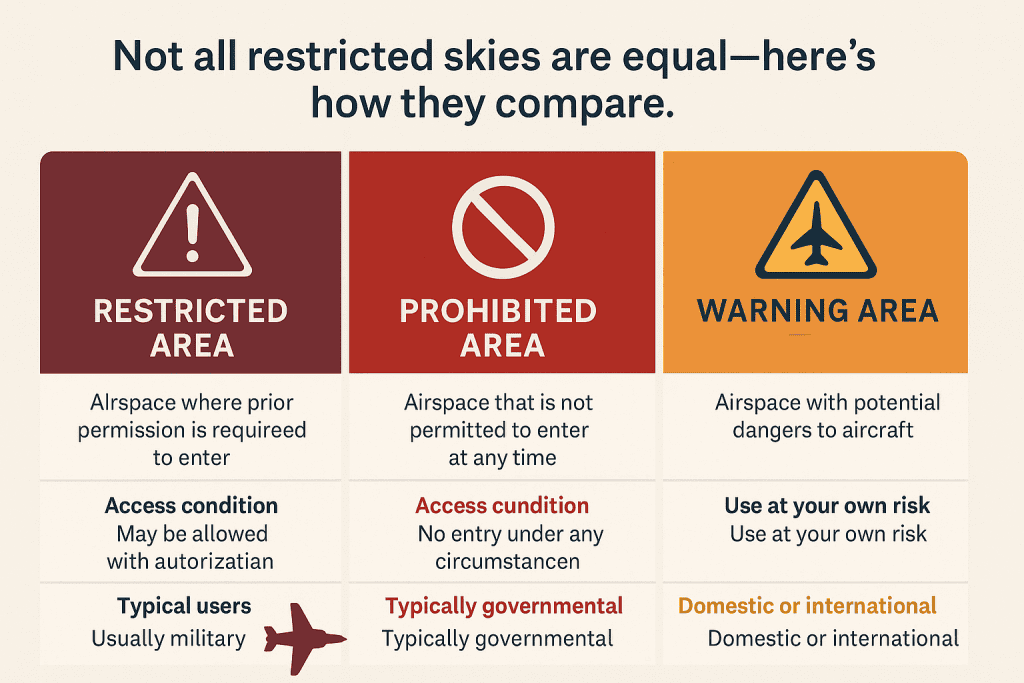
Here’s a quick comparison to help you understand where restricted airspace stands among other special-use airspaces:
| Type | Entry Allowed? | Typical Use |
| Restricted | Only with permission | Military training, weapons testing |
| Prohibited | Absolutely not | Security areas (e.g., White House) |
| Warning Area | Over international waters | Possible danger (similar to restricted) |
| MOA (Military Ops) | Often okay for VFR flights | Military maneuvers |
So, while prohibited airspace is completely off-limits, restricted airspace can be entered— but only under specific conditions and usually when inactive.
🛡 Who Establishes Restricted Airspace—and Why?
Restricted airspace is not randomly assigned. It’s created by government agencies, usually in coordination with aviation authorities, to protect both those on the ground and those in the sky.
The reasons for designating restricted airspace include:
- Military exercises or live weapons testing
- National security operations
- Hazardous aerial work (such as drone testing or rocket launches)
- Special government projects (you’ve probably heard of Area 51, right?)
In the U.S., the Federal Aviation Administration (FAA) coordinates with the Department of Defense or other federal agencies. Internationally, countries define their own restricted areas in accordance with ICAO standards.
🌍 Real-World Examples of Restricted Airspace
Here are some well-known examples of restricted airspace around the world:
- R-4808N (Area 51, Nevada, USA): One of the most secretive and heavily restricted zones, believed to host experimental aircraft testing.
- P-56 (Washington, D.C.): Covers the White House, the Capitol, and major landmarks—completely off-limits without presidential-level clearance.
- North Korean Airspace: Commercial airlines avoid this airspace entirely due to political tensions and unpredictability.
- Indian Military Restricted Zones: Large sections of Indian airspace are routinely closed for military drills.
🚨 What Happens If a Pilot Violates Restricted Airspace?
Accidentally or intentionally flying into restricted airspace is a big deal. The consequences vary depending on the country and the zone’s level of sensitivity:
- Military Scramble: Fighter jets may be dispatched to intercept the intruding aircraft.
- ATC Intervention: Air Traffic Control may order the pilot to immediately divert or land.
- Penalties: Pilots could face license suspension, fines, or criminal charges.
- Public Incidents: In extreme cases, it can lead to diplomatic conflicts or media scandals.
🧠 Remember: Most airspace violations happen because pilots forget to check NOTAMs or misunderstand navigation data.
🧭 How Pilots Avoid Restricted Airspace
Pilots have several tools and procedures to avoid accidentally flying into restricted zones:
- NOTAMs (Notice to Airmen): These are published alerts about airspace activity, restrictions, or changes.
- Flight Planning Software: Apps like ForeFlight, SkyVector, or Garmin Pilot clearly mark restricted areas on digital maps.
- ATC Assistance: Air traffic controllers monitor aircraft closely and will warn pilots if they’re approaching restricted zones.
- Aircraft GPS and FMS Systems: Modern avionics include built-in airspace warnings.
🚁 What About Drones and Restricted Airspace?
Drone pilots are also bound by restricted airspace rules, often even more strictly than manned aircraft.
- In many countries, drones cannot be flown near airports, military bases, or national monuments.
- Apps like DJI’s Fly Safe, B4UFLY (US FAA), and DroneAssist (UK) provide real-time airspace information.
- Violating restricted drone zones can result in fines, confiscation, or criminal prosecution.
🧩 Conclusion: Know Before You Go
Understanding restricted airspace is essential—whether you’re a commercial pilot, flight student, or drone hobbyist. It’s not just about avoiding danger, but also about following regulations that keep everyone in the air (and on the ground) safe.
Always check the current NOTAMs and flight planning resources before flying. When in doubt, consult air traffic control or local aviation authorities.
✈️ The sky is big—but not all of it is yours to fly.
💬 Your Turn:
Have you ever had to reroute around restricted airspace? Do you use any specific tools to help with airspace awareness? Let us know in the comments below!